
What lands in
your inbox.
One architecture, every engagement. The framework collects, the Vault holds the evidence, and seven chapters carry the answer. Curated outputs, scoped to your category — never a data dump.
What actually lands.
Four stages, in order. Everything upstream exists so the seven chapters can be trusted, and everything downstream exists so they get used.
Category Intelligence Framework
How the inputs are collected. Markets, languages, brand set, platform mix and the listening window — scoped to your category before a single record is read.
The Vault
Corpus and signals. Every record screened, de-duplicated and provenance-traced. You inherit its proof, never its contents.
Seven chapters
The Consumer · Consumer Behaviour · Cohorts & Audiences · Demand Ledger · Brand Health · Category Verdict · Go To Market.
The analysis layer
The report never ships alone. We read it with you — and read your own concepts against the demand the category actually shows.
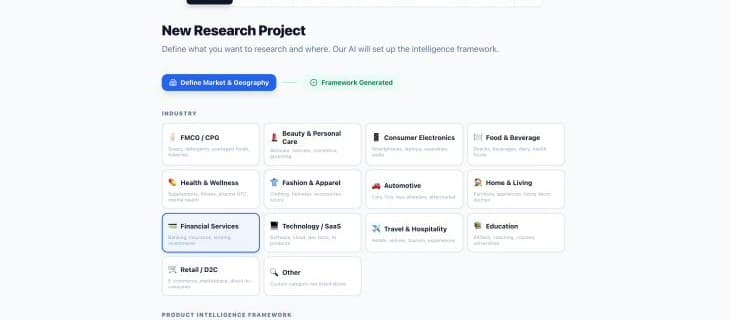
From a live run — specialty home insurance, US.
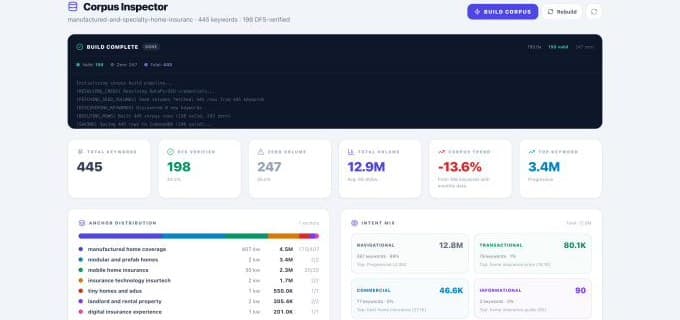
445 keywords. 198 volume-verified. 12.9M monthly volume.
Every report, the same seven chapters.
Open any one.
Chapters one to five are revealed data. Six and seven are the move. They build on each other — by chapter seven you are looking at the next decision, not a summary.
Who this category is actually for, described the way they describe themselves. The rituals and daily practices the product sits inside, and the three layers of need underneath them: what it has to do, how it has to make them feel, and what it has to say about them. Need-state architecture, not topic clouds — and always in the consumer’s own vocabulary rather than the category’s.
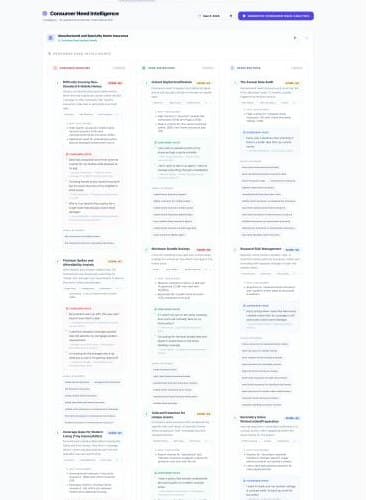
Need-state architecture, with consumer language.
What starts the search, what closes it, and what breaks it. We map the journey from the trigger event through consideration to purchase and to what happens afterwards — including the difference between who is loudest in the category and who actually signs off. Reviews will celebrate one decision-maker at length; the evidence routinely shows a different person changing the brand.
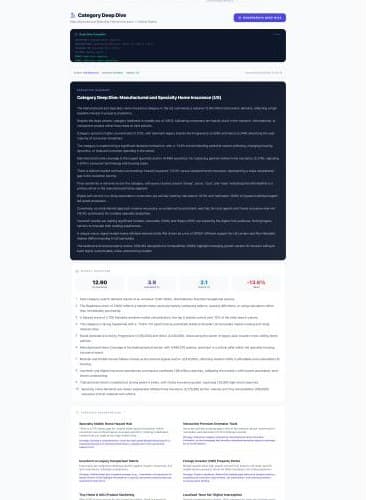
Executive summary, drivers, barriers, brand landscape.
How the audience splits behaviourally rather than demographically. Archetypes drawn from what people actually do, lifestage segmentation where the category turns on it, and the separation that matters most in almost every category we read: the first-time buyer arriving with a problem, against the repeat buyer maintaining a routine. The two want different things and respond to different arguments.
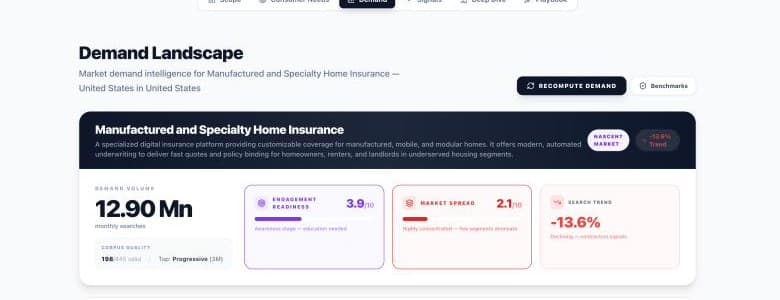
12.9M searches. Readiness 3.9. Spread 2.1. Trend −13.6%.
The five-metric read: Demand Index (magnitude), Engagement Readiness (composition), Demand Spread (diversification), Demand Over Time (momentum), and Buying Intent Index (efficiency). Verified monthly volumes rather than index scores, mapped against occasions and seasonality. Each metric is benchmark-calibrated across categories, so “high readiness” means high relative to a defined universe — not vibes.
Where your brand and its peers sit in the category conversation, and on what. A driver heatmap showing which attributes each brand actually owns in consumer language, the triggers that move a buyer from one brand to another, and — where the evidence base supports it — a read down to variant level. Every brand comparison is run on the same dimensions over the same window, so the numbers are comparable rather than merely adjacent.
Every need in the category sorted into met, partially met, and unmet — then the unmet ones ranked by the demand sitting behind them. This is where the report stops describing and starts deciding. The biggest openings are rarely a product nobody has built; more often they are a promise nobody has proved, or an audience already asking for you by name that the category has never addressed.
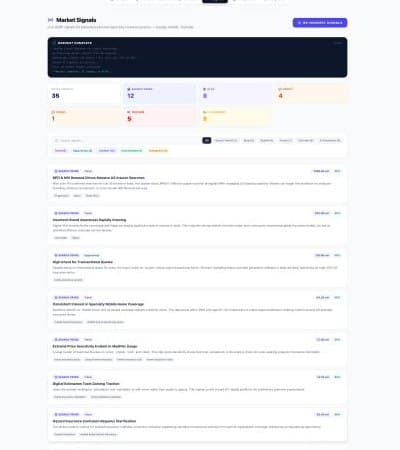
35 live signals. 12 emerging behaviours. 4 urgent.
The bridge from intelligence to action. The entry move, the channel sequence, the messaging architecture, and the pack and pricing read — including the price points where search demand drops away. Every recommendation traces back to a specific finding in the report, so when leadership asks “why this”, the answer is in the evidence rather than the deck.
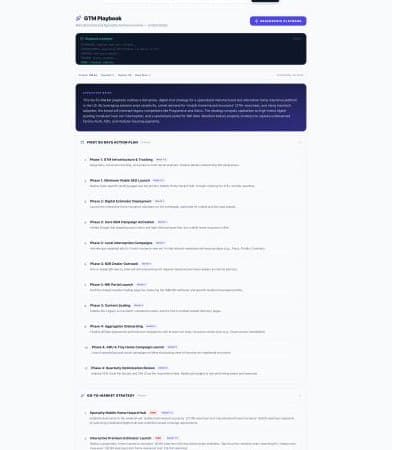
First 90 days. Channel plan. Pricing. Content. Risks.
Previews are real platform output from a US specialty home insurance run. Every report is custom-scoped to your category, market, and brief — no template, no off-the-shelf deliverable. Client name withheld.
Five calibrated metrics. One read.
Each metric is benchmark-calibrated across categories. So when we say “high readiness”, we mean it relative to a defined universe — not vibes.
Demand Index
How big is this category, in absolute search volume?
Engagement Readiness
Are consumers in research mode or buying mode?
Demand Spread
Concentrated in head-terms or distributed across long-tail?
Demand Over Time
Is the category growing, plateauing, or contracting?
Buying Intent Index
How decisive is the audience once they show up?
The chart at the end.
Your category set mapped on Buying Intent Index against Demand Over Time. One chart. Four quadrants. Where to invest, where to defend, where to place strategic bets, and where to walk away.
Lead with these.
High scale, decisive audience, accelerating demand. Defend market share aggressively and price for premium positioning.
Hold the line.
Large category, lower decisiveness. The audience is in research mode — fix the funnel before competitors do.
Place small bets.
Small base, decisive audience. Niche but high-margin — ideal for premium sub-brands or specialist plays.
Walk away (mostly).
Structurally weak: small, fragmented, decelerating. Re-enter only if there is a specific structural reason to play.
Why numbers hold up.
Rigour is a production standard, not a promise. Six rules govern every figure that reaches you — with methodology, evidence graph and correction log maintained behind each one.
Every figure states its base
No percentage travels without the denominator it was computed on.
n is evidence items
Never search volume, never impressions. The unit is a record a human wrote.
Thin cells are flagged directional
Where the base is too small to carry a claim, we say so on the page.
Every verbatim traces to source
Platform, date and record — recoverable from the Vault on request.
A “how to read” section, always
What the numbers are, what they are not, and what they cannot tell you.
Quality gates run before analysis
Relevance, spam and duplicate removal, record-quality screening — evidence is screened, not scraped.
Read the idea first.
The concepts already on your table, read against the demand your category actually shows — before the spend commits.
The concepts you already have
Positionings, claims, pack ideas, NPD candidates — however rough. No new fieldwork, no new brief, no panel to recruit.
Your category’s revealed demand
Ranked whitespace, met and unmet needs, demand spread and trend, and the vocabulary consumers actually use when they talk about the problem.
A read on every idea
Which needs it answers and how strongly, where the demand underneath it is thin, what it collides with, and the language it has to win in.
Not a survey. Not a score.
No claimed preference, no synthetic respondents. Screening against evidence — so the weak ideas fall early and the strong ones sharpen.
Screening sharpens what already exists. Building the stronger idea is where this goes next.
A report is a conversation, not a PDF.
Six weeks of traditional research, compressed into roughly two. Every engagement includes a 60-minute working session — the PDF is the artefact, the conversation is the value.
- 01Day 0
Brief
You share the question — written or unwritten. Thirty minutes.
- 02Day 2
Scope
We agree the boundaries in writing before any data is touched.
- 03
Build
The platform runs. The analyst reads. Roughly two weeks.
- 04Day 15
Walkthrough
A 60-minute working session. Pressure-test the implications.
- 05
Deliver
PDF outputs, scoped to your team. Ongoing access optional.
Start with a brief.
A finished question, a half-formed idea, or just a category you want to understand. We’ll take it from there.